When I began my work with Klinic, one of the programs that intrigued me from the start was Manitoba Farm, Rural and Northern Support Services (MFRNSS). Perhaps it was my own rural roots, but I was inspired by the ability of Klinic to leverage their incredible capacity providing crisis support, (including managing 11 different lines in our province like the Manitoba Suicide Prevention & Support Line), and then further work with Brandon and surrounding rural and northern networks to establish supports that would resonate locally. At Klinic, our community is everywhere you look. To work with MFRNSS, you must have farm and/or rural experience. Farming is stressful. If you have farmed personally or grown up in a farming community, you likely are well aware of this. In fact, some of the statistics are staggering (I will discuss this later in this blog). Last spring I had the opportunity to attend the Royal Manitoba Winter Fair in Brandon, which you can read about here, which is where I made a commitment to come back for Ag Days. Ag Days, in its 41st year, is Canada’s largest indoor farm show; it sees approximately 50,000 people over three days (Jan. 16-18). Klinic’s own MFRNSS is featured as one of the farm safety groups, a role we have been doing for a very long time with the assistance of Leanne Brackenreed, counsellor with the MFRNSS and active farmer. Leanne coordinates the display every year and does an amazing job of creating a welcoming booth. I was able to tour Ag Days with Leanne, which was a great opportunity to see it through her eyes; we talked quite a bit about her farm. Leanne’s family farm is considered a 4- generation farm, being in the family for over a century; her daughter is now farming there too.  This year’s MFRNSS theme is: ‘Healthy Farmers = Healthy Farms’ and was marketed through t-shirts, help cards, magnets and a banner at our booth, made possible with a helpful donation from a community organization who lost a farmer to suicide. We know that when farmers are stressed, it can cause physical and mental health issues. Taking care of oneself and managing stress is good for the individual, their families (many of whom also work on the family farm), and their communities. The bottom line is a healthy farmer is also a safer farmer. Research suggests that farmers are at greater risk of farm accidents when their stress is high.
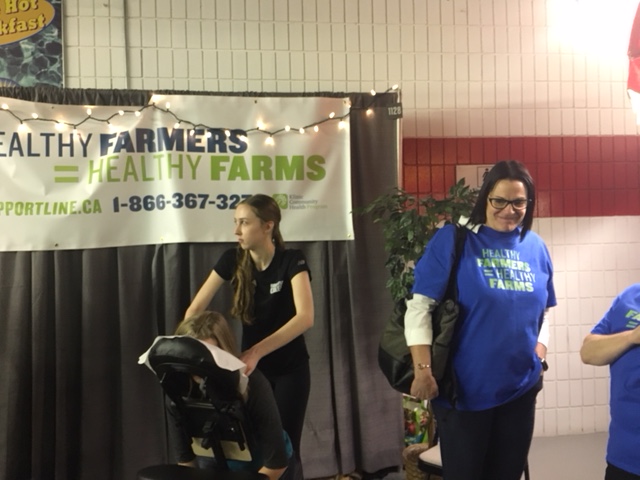
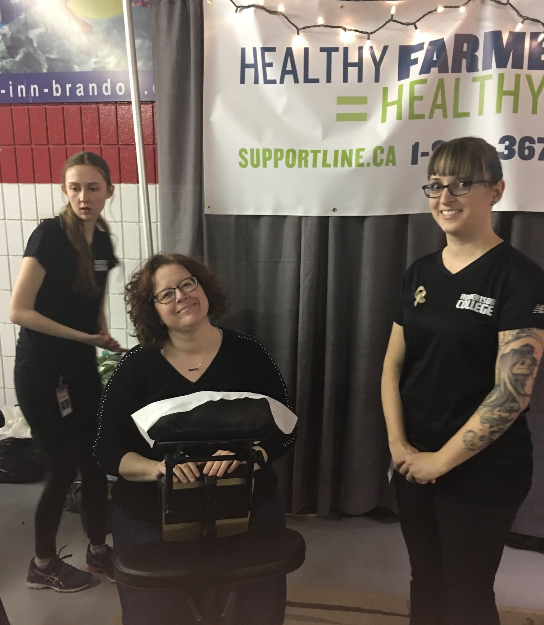
  At Ag Days, we partner with Robertson College to offer free massages for folks who come to our display – a great way to get people into our booth and spread the message of self-care. Fascinating side note: do you know what ‘farmer’s neck’ is? That is when a farmer looks over the same shoulder for years on the tractor, and it causes intense neck strain. Most farmers do not have private insurance, as they are largely self-employed, so have no massage benefits (or EAP for that matter).
  One of the reasons I wanted to be at Ag Days this year was that our Manager Janet Smith was moderating a panel on Mental Health in Agriculture. The panel featured a mental health expert from Brandon (and former MFRNSS staff) as well as two farmers from Saskatchewan who shared their personal stories with mental health. They have both been very active on social media this past year championing the cause and breaking down stigma. Listening to Kim Keller and Lesley Kelly speak about their and their families’ personal experiences with mental health crises was very impactful for me personally. Looking around the room, I have no doubt carried a lot of impact for the many rural families who had come to listen. The University of Guelph recently completed a stress and resiliency study on farmers across Canada, and much of the data reminds us that farmers have higher stress levels than the general population, lower help-seeking behaviours, and (surprisingly) lower resilience. In fact, 45% reported high stress, 35% depression, 58% reported experiencing anxiety and 40% said they would not seek help. A United States study found that farming across the border is one of the top occupations related to dying by suicide. In Canada, these statistics are not available.
  What are Canadian farmers stressed about? One of the panelists asked the audience this, and here is what they shared:
This year’s MFRNSS theme is: ‘Healthy Farmers = Healthy Farms’ and was marketed through t-shirts, help cards, magnets and a banner at our booth, made possible with a helpful donation from a community organization who lost a farmer to suicide. We know that when farmers are stressed, it can cause physical and mental health issues. Taking care of oneself and managing stress is good for the individual, their families (many of whom also work on the family farm), and their communities. The bottom line is a healthy farmer is also a safer farmer. Research suggests that farmers are at greater risk of farm accidents when their stress is high.  At Ag Days, we partner with Robertson College to offer free massages for folks who come to our display – a great way to get people into our booth and spread the message of self-care. Fascinating side note: do you know what ‘farmer’s neck’ is? That is when a farmer looks over the same shoulder for years on the tractor, and it causes intense neck strain. Most farmers do not have private insurance, as they are largely self-employed, so have no massage benefits (or EAP for that matter). One of the reasons I wanted to be at Ag Days this year was that our Manager Janet Smith was moderating a panel on Mental Health in Agriculture. The panel featured a mental health expert from Brandon (and former MFRNSS staff) as well as two farmers from Saskatchewan who shared their personal stories with mental health. They have both been very active on social media this past year championing the cause and breaking down stigma. Listening to Kim Keller and Lesley Kelly speak about their and their families’ personal experiences with mental health crises was very impactful for me personally. Looking around the room, I have no doubt carried a lot of impact for the many rural families who had come to listen. The University of Guelph recently completed a stress and resiliency study on farmers across Canada, and much of the data reminds us that farmers have higher stress levels than the general population, lower help-seeking behaviours, and (surprisingly) lower resilience. In fact, 45% reported high stress, 35% depression, 58% reported experiencing anxiety and 40% said they would not seek help. A United States study found that farming across the border is one of the top occupations related to dying by suicide. In Canada, these statistics are not available.
  What are Canadian farmers stressed about? One of the panelists asked the audience this, and here is what they shared:
 - The weather
- NAFTA
- Debt
- Succession planning